02 — CATHOLICISM
Faith carried in a Hmong voice.
Conversion, memory, language, and the continuing work of understanding what can be carried forward.

Catholicism did not enter an empty space
Before encountering Christianity, Hmong communities already possessed developed systems of family obligation, healing, funeral practice, relationships with ancestors, and understandings of the visible and spiritual worlds. Traditional religion is not the only Hmong religious identity. Hmong people today include Catholics, Protestants, Buddhists, people who continue traditional practices, people who combine inherited customs in different ways, and people who are not religious.
The arrival of Catholicism
There is no single moment when “the Hmong became Catholic.” Catholicism entered different communities at different times through missionaries, local catechists, marriages, family networks, schools, refugee sponsorship, and the decisions of individual households.
The Martyrs of Laos
Between 1954 and 1970, seventeen Catholics were killed in Laos — missionary priests from France and Italy, a Lao priest, and Lao, Hmong, and Kmhmu catechists and lay leaders — during a period of anti-religious persecution under the Pathet Lao communists. The Catholic Church declared them martyrs on December 11, 2016, in Vientiane. They are collectively known as "Joseph Thao Tien and his sixteen companions."
Among them was an ethnic Hmong lay catechist, Paul Thoj Xyooj, who was killed alongside Italian missionary Father Mario Borzaga near the Chinese border. He is recognized as the first Laotian martyr from the Hmong ethnic group, and a church in Vientiane province was later dedicated in his name.
Paul Thoj Xyooj's nephew was Father Tito Banchong Thopanhong — meaning the priest who later served as Apostolic Administrator of Luang Prabang carried this history inside his own family.

Father Tito Banchong Thopanhong and the Church in Laos
Father Tito Banchong Thopanhong was born in 1947 in the Hmong village of Kiukiatan in northern Laos. Baptized as a child, he studied in seminaries in Laos and later continued his formation in Italy.
In 1975, as missionaries were being expelled and political power in Laos was changing, he chose to return. He was ordained in Vientiane on September 28, 1975, becoming the first priest from the Hmong ethnic group. He was later imprisoned several times and spent seven years in prison, yet resumed pastoral work after his release. From 1999 to 2019, he served as Apostolic Administrator of Luang Prabang.
His life gives Hmong Catholic history a human face. The history is not only about missionary institutions. It is also about a Hmong priest who chose to return to a difficult and isolated Church because he believed his people needed a pastor.
Hmong Catholic life in northern Vietnam
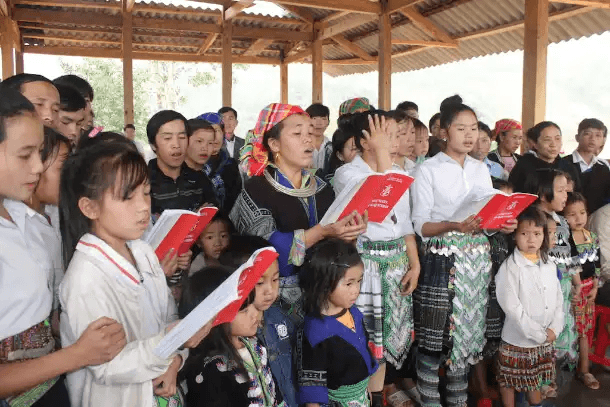
In 2021, Father Joseph Ma A Ca was ordained as the first Hmong Catholic priest in Vietnam. He described serving Indigenous villages, educating children, and helping preserve Hmong language and cultural traditions as priorities of his ministry. In remote communities, Catholic life has often depended on the persistence of families, catechists, religious sisters, and priests traveling between distant villages.
Hmong Catholics in the United States
Catholic churches were among the communities that sponsored and welcomed Hmong refugees after 1975. Within the Diocese of La Crosse, Hmong families settled principally in Wausau, La Crosse, and Eau Claire.
In 1987, Bishop John Paul wrote a pastoral letter addressing the Christian welcome and continued formation of Hmong Catholics. Decades later, Hmong leaders petitioned for a parish that could serve their community more directly. Mary, Mother of Good Help Parish was established in Wausau on May 8, 2018, with Father Alan Burkhardt as its first pastor.
The parish describes itself as the only dedicated Hmong Catholic parish in the United States — not the first, but so far the only one. (marymotherofgoodhelp.org)
Conversion and culture are not the same thing
Catholic conversion creates real theological boundaries. Yet conversion does not require a Hmong person to stop being Hmong. Language, kinship, care for elders, food, clothing, embroidery, family history, hospitality, music, and communal responsibility cannot all be reduced to religion. The difficult questions arise where cultural and religious meanings are intertwined — especially around illness, ancestor rites, death, and funerals.
Why language matters
Faith becomes more intimate when people can pray, teach, confess fear, and name hope in the language they use with their families. Hmong-language prayer allows parents and grandparents to pass on faith without first translating their lives into another language.
The goal is not to describe two worlds in permanent conflict. It is to identify where tensions are real, where false divisions have been created, and where careful understanding can replace silence.
